



 Before starting an optimization of
the firing rate control (FRC), it is
mandatory to define all
objectives or aims.
First of all the actual situation
needs to be determined and
defined:
* Are all guarantees complied with?
* Are there problems with certain waste fractions?
* Is the burn-out guaranteed at all times?
* Do O2-drops and / or CO-peaks occur?
* Is the bandwidth (range) of steam production too
high?
* How often is a manual interception necessary?
* Are there corrosion problems?
* Is there a build-up of slack on the walls?
* Are the repair intervals too short?
* Are there conflicting objectives?
Before starting an optimization of
the firing rate control (FRC), it is
mandatory to define all
objectives or aims.
First of all the actual situation
needs to be determined and
defined:
* Are all guarantees complied with?
* Are there problems with certain waste fractions?
* Is the burn-out guaranteed at all times?
* Do O2-drops and / or CO-peaks occur?
* Is the bandwidth (range) of steam production too
high?
* How often is a manual interception necessary?
* Are there corrosion problems?
* Is there a build-up of slack on the walls?
* Are the repair intervals too short?
* Are there conflicting objectives?

 Objectives
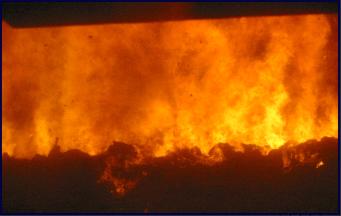
Burning municipal and industrial waste in waste incineration plants requires a sophisticated control strategy for waste feeding,
transportation of the burning waste on the grates as well as for controlling the air. Aside from achieving the desired burn-out quality,
the aim of a good firing rate control is to stay within a narrow range of excess air. This will allow for a good boiler efficiency. At the
same time it will contribute to avoid unwanted flue gas compositions (e.g. CO). From a commercial viewpoint it is desirable not only to
meet all legal requirements but also to have a maximum of steam production while keeping the service life of the plant high.
Experience has shown that generally all suppliers of waste incineration plants meet their guaranteed values at the end of the time of
commissioning. The maximum efficiency of an existing plant, however, can only be achieved once the plant has been successfully
commissioned. This requires a profound knowledge of the physical and chemical processes in combination with the time behaviour of
these processes. It is not common that operators of a plant perform such an optimization .
Objectives
Burning municipal and industrial waste in waste incineration plants requires a sophisticated control strategy for waste feeding,
transportation of the burning waste on the grates as well as for controlling the air. Aside from achieving the desired burn-out quality,
the aim of a good firing rate control is to stay within a narrow range of excess air. This will allow for a good boiler efficiency. At the
same time it will contribute to avoid unwanted flue gas compositions (e.g. CO). From a commercial viewpoint it is desirable not only to
meet all legal requirements but also to have a maximum of steam production while keeping the service life of the plant high.
Experience has shown that generally all suppliers of waste incineration plants meet their guaranteed values at the end of the time of
commissioning. The maximum efficiency of an existing plant, however, can only be achieved once the plant has been successfully
commissioned. This requires a profound knowledge of the physical and chemical processes in combination with the time behaviour of
these processes. It is not common that operators of a plant perform such an optimization .




 As soon as the objectives for
the optimization of the firing
rate control (FRC) have been
defined by the operator of the
plant, a logical sequence of
activities is determined and
will be executed accordingly. It
is the aim to reach an economical and optimal
setting as fast as possible.
With this in mind a whole array of boundary
conditions are checked out:
* Which signals / measurements can be used
additionally?
* Which circuits (modules) need to be
incorporated additionally?
* Which alternate mode of operation or settings
for the existing control structure could lead to
an improved result?
As soon as the objectives for
the optimization of the firing
rate control (FRC) have been
defined by the operator of the
plant, a logical sequence of
activities is determined and
will be executed accordingly. It
is the aim to reach an economical and optimal
setting as fast as possible.
With this in mind a whole array of boundary
conditions are checked out:
* Which signals / measurements can be used
additionally?
* Which circuits (modules) need to be
incorporated additionally?
* Which alternate mode of operation or settings
for the existing control structure could lead to
an improved result?

 Procedure







 The thermal treatment of
municipal and industrial
waste has been
established all over the
world to a great extend. All
waste incinerators which
have been commissioned
so far, have to cope with
the same boundary conditions and if applicable also
with the same problems. In many cases the capability
of the grates in reference to the expected waste
throughput is overestimated. In Asian countries very
often you will find municipal waste consisting
predominantly of vegetables. This may result in low
calorific values, sometimes even below 6000 kJ/kg.
The requirements for a FRC increase with the
decrease of the calorific value. Practical experience
with problematic calorific values in Japan and Korea
(and as reported also in China) support this
observation. Hence the requirements for a FRC are
higher in Asia than, for example in Scandinavia.
The thermal treatment of
municipal and industrial
waste has been
established all over the
world to a great extend. All
waste incinerators which
have been commissioned
so far, have to cope with
the same boundary conditions and if applicable also
with the same problems. In many cases the capability
of the grates in reference to the expected waste
throughput is overestimated. In Asian countries very
often you will find municipal waste consisting
predominantly of vegetables. This may result in low
calorific values, sometimes even below 6000 kJ/kg.
The requirements for a FRC increase with the
decrease of the calorific value. Practical experience
with problematic calorific values in Japan and Korea
(and as reported also in China) support this
observation. Hence the requirements for a FRC are
higher in Asia than, for example in Scandinavia.

 Experience


 Welcome

 Optimizing The Control of Waste Incineration Plants
 Dipl-Ing.Dipl.-Wirtsch.Ing
Heinz-Helmut Voje
Optimierung von Feuerleistungsregelungen für
Optimizing Firing Rate Controls for
Müllverbrennungsanlagen
Waste Incineration Plants
Dipl-Ing.Dipl.-Wirtsch.Ing
Heinz-Helmut Voje
Optimierung von Feuerleistungsregelungen für
Optimizing Firing Rate Controls for
Müllverbrennungsanlagen
Waste Incineration Plants






 more
more
more
more